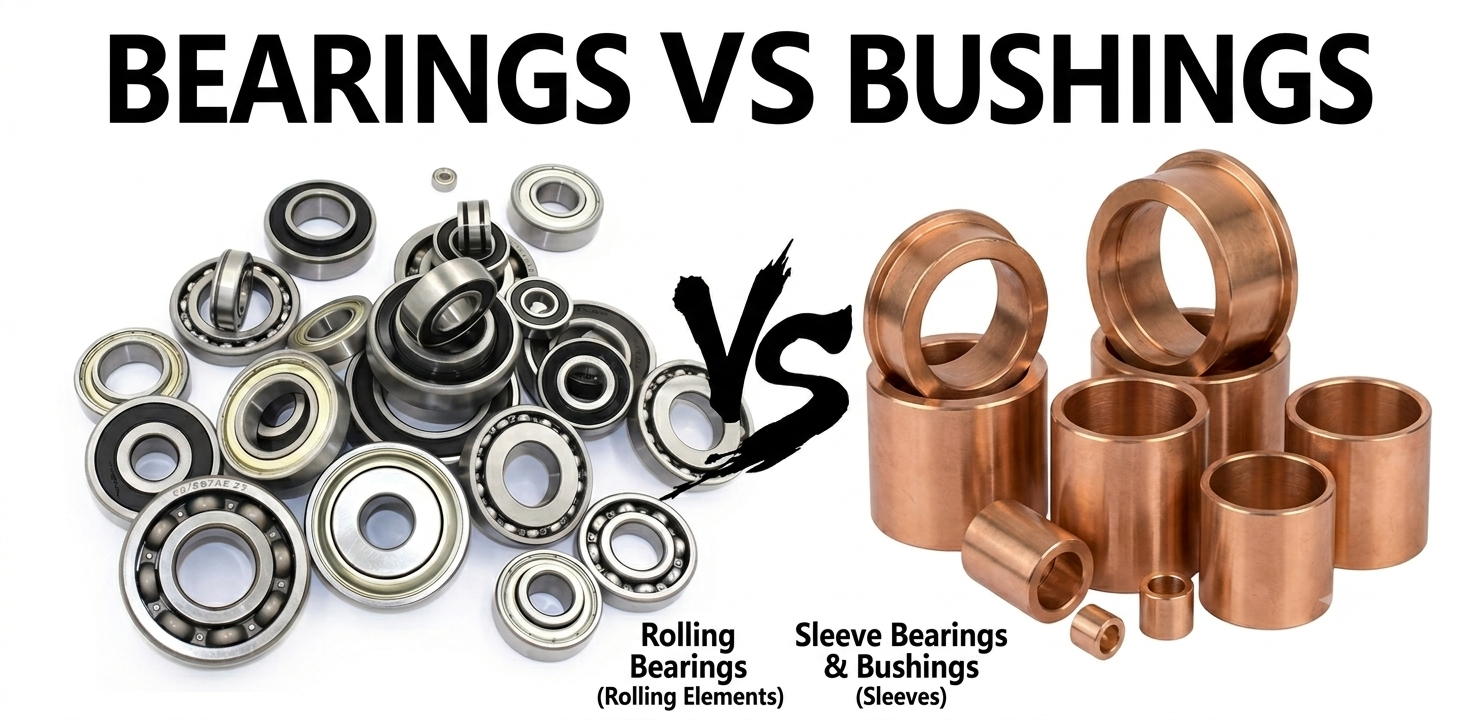
Quick answer: A bushing is a single-piece plain bearing that carries load through a sliding contact, while a “bearing” usually means a rolling-element bearing that uses balls or rollers. Bushings are cheaper, more compact, and better at absorbing shock and tolerating dirt at low to moderate speeds. Rolling bearings run faster with less friction. Strictly speaking, a bushing is just one type of bearing.
Table of Contents
- Why “bearing vs. bushing” is even a question
- What is a bushing?
- Bearing bush, bushing bearing, bush bearing: one part, many names
- What is a bearing (the rolling kind)?
- Bearing vs. bushing: side-by-side
- When to use a bushing vs. a bearing
- What bushings are made of
- Bushing options from Precision Bronze
- FAQ
- Key takeaways
Why “Bearing vs. Bushing” Is Even a Question
Walk through one maintenance shop and you’ll hear the two words used for the same part. Walk through the next and you’ll hear them used for opposite parts. That’s where the confusion comes from, and the catalogs don’t help: the same component gets sold as a “bushing” on one site, a “sleeve bearing” on another and a “bearing bush” on a third.
Here’s the clean version. A bushing is a plain bearing, a single sleeve of bearing material that the shaft slides against directly. A rolling bearing puts hardened balls or rollers between two races so the surfaces roll instead of slide. Technically a bushing sits inside the larger family of bearings, which is exactly why you’ll see it called a “sleeve bearing” or “plain bearing” as often as a “bushing.”
So when someone asks “do I need a bearing or a bushing,” the real question is almost always simpler: sliding contact or rolling contact? Get that decision right and the part you order takes care of itself.
What Is a Bushing?
A bushing is the simplest bearing there is. It’s a cylinder of bearing-grade material pressed into a housing, with the shaft turning or sliding inside the bore. No balls, no rollers, no cage. The bushing and the shaft do all the work between them.
Because there’s nothing moving inside it, a bushing wins on the things that tend to matter in the field:
- It’s compact. The wall is the whole bearing, so it fits in places a ball bearing never could.
- It handles shock and vibration. There are no rolling elements to brinell or flat-spot when the load slams on.
- It’s forgiving. A good bearing bronze lets fine debris embed into the surface instead of scoring the shaft, and it conforms to a shaft that isn’t perfectly true.
- It’s cheap to buy and quick to replace.
The trade-off is friction and speed. A bushing runs on a sliding film, usually oil, grease, or a solid lubricant built into the material itself, and it doesn’t like running fast and dry. Push the pressure-velocity (PV) too high without lubrication and it will heat up, glaze, and eventually seize.
Material is most of the story, which is why the same sleeve gets specified in half a dozen different alloys depending on the duty. More on that below.
Bearing Bush, Bushing Bearing, Bush Bearing: One Part, Many Names
Search for this part and you’ll meet a handful of names for the same thing. “Bushing” is the usual American word; “bush” or “bearing bush” is the British, Indian and Australian one, so bearing bushes and bronze bushings are the same parts. “Bushing bearing,” “bearing bushing” and “bush bearing” all mean a plain bearing in the form of a bushing, while “sleeve bearing,” “plain bearing” and “journal bearing” describe it by what it does. Catalogs that list “bearings and bushings” side by side usually mean rolling bearings in one section and plain bushings in the other.
One name breaks the pattern. A ball bushing bearing, or linear ball bushing, is a rolling bearing for straight-line motion along a shaft: recirculating balls run inside a sleeve. It looks like a bushing from the outside but works like a ball bearing, with the same speed advantages and the same sensitivity to dirt and shock.
What Is a Bearing (the Rolling Kind)?
When people say “bearing” without qualifying it, they almost always mean a rolling-element bearing. Hardened balls or rollers sit between an inner and outer race, held apart by a cage, so the contact rolls rather than slides. Rolling friction is far lower than sliding friction, and that’s the whole point of the design.
Low friction is what lets a rolling bearing spin fast and stay cool doing it. Pick the right geometry and it will take load from almost any direction:
- Ball bearings carry moderate radial and some axial load at high speed. The default for electric motors and spindles.
- Roller bearings (cylindrical, needle, tapered) take heavier loads, with tapered rollers built for combined radial and axial load like wheel hubs.
- Thrust bearings take pure axial load.
The cost of all that is complexity. A rolling bearing is several precision parts assembled to tight tolerances, so it’s more expensive, more sensitive to contamination, and less tolerant of shock or a bore that’s gone out of round. Let dirt past the seal or run it dry, and the rolling elements are the first thing to fail.
Bearing vs. Bushing: Side-by-Side
| Bushing (plain bearing) | Rolling bearing | |
|---|---|---|
| Contact | Sliding | Rolling |
| Construction | One piece | Multiple precision parts plus cage |
| Speed | Low to moderate | Moderate to very high |
| Friction | Higher, depends on lubrication | Lower |
| Best load type | Heavy, steady, or shock loads | Distributed radial/axial loads at speed |
| Shock and vibration | Absorbs it well | Vulnerable (brinelling, flat spots) |
| Dirt and misalignment | Forgiving (embeds debris, conforms) | Sensitive, wants a clean, aligned bore |
| Lubrication | Oil, grease, or built-in solid lube | Grease or oil, relies on seals |
| Noise | Quiet | Can whine or rumble as it wears |
| Space | Compact, thin wall | Needs more radial room |
| Cost | Low | Several times higher |
| Replacement | Press out, press in | Often a pressed assembly plus housing work |
None of this makes one “better” than the other. It makes them suited to different jobs. A conveyor pulley turning slowly under a dirty, shock-loaded belt is bushing territory. A motor shaft at 3,000 RPM is not.
When to Use a Bushing vs. a Bearing
Reach for a bushing when:
- Speed is low to moderate, and the motion is intermittent or oscillating (pivots, linkages, hinge pins).
- The load is heavy, steady, or arrives in shocks.
- The environment is dirty, wet, or hard to lubricate.
- Space is tight, or you need to cut cost and part count.
- You want a sacrificial part that protects a more expensive shaft or housing.
Reach for a rolling bearing when:
- The shaft runs fast and continuously.
- Friction and running temperature have to stay low.
- Positioning accuracy and minimal play matter.
- Loads are predictable and you can keep the bore clean and aligned.
The gray zone is real. Plenty of slow, heavily loaded pivots could run on either, and the call comes down to cost, maintenance access, and how much abuse the joint sees. One useful tiebreaker: when the application oscillates instead of rotating, a rolling bearing can’t build a proper film and tends to suffer fretting, so a bushing usually wins by default.
What Bushings Are Made Of
For industrial work, “bushing” usually means bronze, and the alloy is chosen around load, speed, lubrication, and environment.
- Leaded tin bronze (C93200 / SAE 660) is the workhorse. It machines cleanly, runs well under boundary lubrication, and conforms enough to forgive an imperfect shaft. It’s the default for most sleeve and flanged bushings.
- Aluminum bronze (C95400) trades some of that forgiveness for strength, so it’s the pick for higher loads and heavier pivots.
- Manganese bronze (C86300) goes further: very high strength for slow-moving, heavily loaded parts like press tooling and construction-equipment bushings.
- Sintered bronze (SAE 841) is porous and pre-filled with oil, so it lubricates itself. Good for light-duty jobs where nobody is going to grease it.
- Graphite-plugged bronze sets a solid lubricant into the bearing face for dirty, dry, or high-temperature service where oil won’t stay put.
- Marine bronze (C95800) adds corrosion resistance for wet and saltwater work.
Outside of bronze, plastic and PTFE-lined bushings handle light loads, corrosive media, and food-grade or maintenance-free requirements where you don’t want metal on metal.
Bushing Options from Precision Bronze
Once you’ve settled on a plain bearing, the next question is how the load comes in. That’s what separates the three most common bronze bushing types.
- Radial load (a shaft turning inside a bore) is the job for a bronze sleeve bushing. It’s the plain cylinder described above, machined from continuous cast C93200 by default, with oil or grease grooves added to suit the duty.
- Radial load plus axial location calls for a flanged bushing. The integral flange gives the housing a positive shoulder so the bushing can’t walk through the bore, and it doubles as a light thrust face, which saves adding a separate washer.
- Axial (thrust) load is handled by a bronze thrust washer. It’s a sacrificial bearing face between rotating parts, often grooved or graphite-plugged, so you replace a cheap washer instead of a gear or housing.
All three are made to print in inch or metric sizes, in C93200 as standard or in higher-strength and self-lubricating alloys when the load, speed, or environment asks for it. If you’re replacing a failed part, sending the shaft diameter, housing bore, and target running clearance will get you a quote faster than a description ever will.
FAQ
Is a bushing the same as a bearing? A bushing is a type of bearing, specifically a plain (sliding) bearing. The everyday distinction people make is between a bushing and a rolling-element bearing: the bushing slides, the rolling bearing rolls.
What is a bushing made of? Most industrial bushings are bronze: leaded tin bronze (C93200) for general use, aluminum or manganese bronze for higher loads, and sintered or graphite-plugged bronze where lubrication is poor. Plastic and PTFE-lined bushings cover light-duty, corrosive, or maintenance-free jobs.
Which is cheaper, a bushing or a bearing? A bushing, by a wide margin. With one machined part and no rolling elements or seals, it usually costs a fraction of an equivalent rolling bearing, both to buy and to replace.
Do bushings need lubrication? Most do. They run on an oil or grease film, often fed through grooves in the bore. Sintered bushings carry their own oil and graphite-plugged bronze lays down a dry film, so both can run with little or no added lubrication.
Can a bushing replace a bearing? Sometimes. For slow, heavily loaded, or oscillating joints, a bushing is often the better choice to begin with. For high speed or low-friction requirements, it can’t stand in for a rolling bearing.
Which lasts longer, a bushing or a bearing? It depends on the duty. In clean, high-speed service a rolling bearing lasts longer. In dirty, shock-loaded, or poorly lubricated conditions, a bronze bushing often outlives it.
Is a sleeve bearing or bearing bush the same as a bushing? Yes. “Sleeve bearing,” “plain bearing,” “bearing bush,” and “bushing” all describe the same single-piece sliding bearing; “bush” is simply the British word.
What are ball bushing bearings? Linear ball bearings: a sleeve with recirculating balls that runs along a hardened shaft for straight-line motion. Despite the name they are rolling bearings, not plain bushings. A bronze bushing does the same guiding job by sliding, at lower speed but with more tolerance for heavy, shock, and dirty loads.
Key Takeaways
- A bushing is a plain bearing that works by sliding; a “bearing” usually means a rolling-element bearing that works by rolling.
- Bushings win on cost, compactness, shock tolerance, and running in dirty or hard-to-lubricate conditions at low to moderate speed.
- Rolling bearings win on high speed, low friction, and positioning accuracy.
- For oscillating or slow, heavily loaded joints, a bronze bushing is usually the right call.
- Match the bushing to the load: sleeve for radial, flanged for radial plus axial location, thrust washer for axial load, and pick the bronze alloy around load, speed, and lubrication.