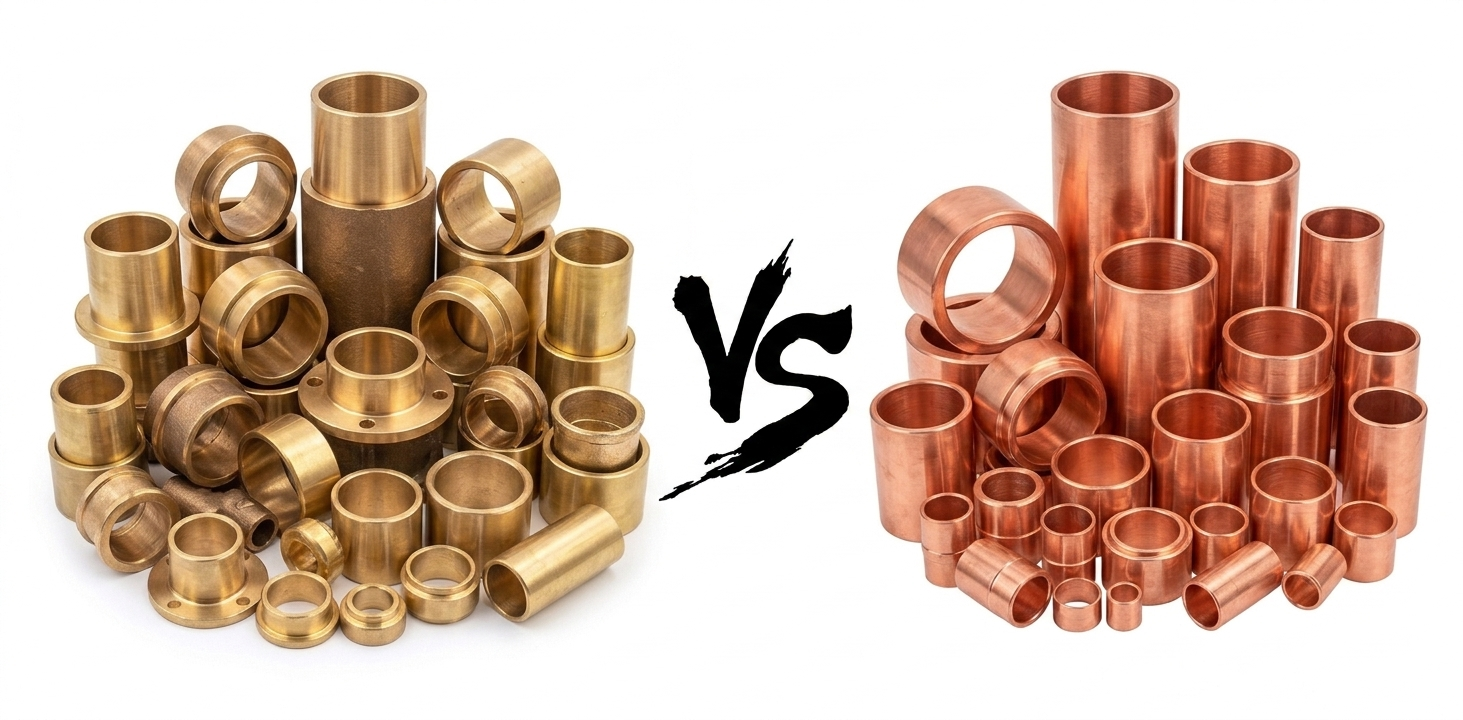
Quick answer: Choose SAE 660 (C93200) when the bearing sees high or shock loads and you can lubricate it. It’s a solid cast bronze that’s stronger, takes impact better, and machines to any size. Choose SAE 841 when the bearing is light to medium duty and hard to reach for greasing: it’s a porous sintered bronze pre-soaked with oil, so it lubricates itself and needs no maintenance.
Table of Contents
- The short answer
- SAE 660 (C93200): cast bearing bronze
- SAE 841: oil-impregnated sintered bronze
- SAE 660 vs. SAE 841: side-by-side
- How to choose between them
- Getting the right part
- FAQ
- Key takeaways
The Short Answer
These are the two most common bronze bearing materials on the shelf, and they get specified almost interchangeably, which is a mistake. They’re made completely differently and they fail in completely different ways.
The single question that settles most jobs is this: can you get oil to the bearing?
If yes, through a gearbox, an oil bath, or a grease fitting, SAE 660 is usually the better pick. It’s a solid cast bronze, it’s stronger, and it takes shock without complaint. If no, because the bearing is buried in a motor, sealed into an assembly, or just somewhere nobody will ever grease, SAE 841 brings its own oil. It’s a porous sintered bronze soaked with lubricant that bleeds to the surface as the shaft turns.
Everything below is detail on top of that one decision.
SAE 660 (C93200): Cast Bearing Bronze
SAE 660 / C93200 is the default cast bronze for general bearing work. It’s a leaded tin bronze, poured as continuous cast bar and then machined into the finished bushing, washer, or sleeve.
SAE 660 equivalent materials: C93200 (short C932), CDA 932, SAE 660, “660 bronze,” high-leaded tin bronze, “bearing bronze.” These all refer to the same alloy.
Composition: roughly 83% copper, 7% tin, 7% lead, and 2.5% zinc. The tin gives it strength, wear resistance, and corrosion resistance; the lead makes it machine cleanly and helps the surface embed grit and conform to a shaft that isn’t perfectly true.
Typical properties (published minimums for engineering review): tensile strength around 35,000 psi, yield around 20,000 psi, Brinell hardness of 55 to 70, and a machinability rating of 70 against free-cutting brass at 100. It’s solid and non-porous, with a density of 0.322 lb/in³.
What that adds up to in service: 660 carries heavier loads than sintered bronze, shrugs off shock and vibration, and holds up at higher temperatures. The catch is that it relies on an external lubricant film. Run it fast and dry and it will overheat and seize, which is why sleeves are usually supplied with oil or grease grooves. Because it starts as solid bar, it can be machined to any size and tolerance, with custom grooves, holes, and wall thicknesses, so it’s also the answer when you need a large or one-off bushing rather than a catalog size.
SAE 841: Oil-Impregnated Sintered Bronze
SAE 841 is the self-lubricating standard, the material most people picture when they hear “Oilite bushing.” Instead of being cast and machined, it’s pressed from bronze powder and sintered, which leaves a controlled network of pores running through the metal.
SAE 841 bronze equivalents: SAE 841, Oilite (a brand name for this material), oil-impregnated sintered bronze, ASTM B438 Grade 1 Type II, MPIF CT-1000-K26, and “self-lubricating bronze.”
Composition: about 90% copper and 10% tin, with no lead. The pore structure is the important part: at least 19% of the volume is open porosity, filled under vacuum with lubricating oil, typically an SAE 30.
How it works: as the shaft turns, it draws a film of oil out of the pores and onto the bearing surface, forming a hydrodynamic film. When the shaft stops, capillary action pulls the oil back in. The bearing carries its own lubricant for the life of the part, with no grease gun required.
SAE 841 bearing bronze properties: lower strength than cast bronze, as you’d expect from a porous material. Compressive yield strength is around 11,000 psi, the K strength constant is about 26,500 psi, elongation is roughly 1%, and density runs 6.4 to 6.8 g/cm³. Like all plain bearings, it’s governed by a PV limit (the product of contact pressure and surface speed), and that limit is lower than 660’s.
In service, 841 is quiet, clean, and maintenance-free, and it’s cheap when bought in volume because it’s pressed close to net shape in standard sizes. The trade-offs are real, though: it doesn’t take heavy or shock loads well, it can’t run as hot before the oil bleeds off, and it isn’t meant for heavy machining from stock. You size and groove it, you don’t turn it down from bar.
SAE 660 vs. SAE 841: Side-by-Side
| SAE 660 (C93200) | SAE 841 (sintered) | |
|---|---|---|
| Type | Cast leaded tin bronze, solid | Sintered powder-metal bronze, porous |
| Composition | ~83 Cu / 7 Sn / 7 Pb / 2.5 Zn | ~90 Cu / 10 Sn, no lead |
| Lubrication | Needs external oil or grease | Self-lubricating, ~19%+ oil in pores |
| Load capacity | High, handles shock | Light to medium, poor with shock |
| Strength | Tensile ~35,000 psi, Brinell 55-70 | Compressive yield ~11,000 psi |
| Speed | Moderate, with lubrication | Low to moderate |
| Temperature | Tolerates higher temperatures | Limited by oil in the pores |
| Machinability | Excellent (rated 70), machine from bar | Limited, sized and grooved only |
| Custom sizing | Any size or tolerance from a drawing | Mostly standard catalog sizes |
| Maintenance | Periodic relubrication | None |
| Cost | Higher per part in low volume | Lower in volume, near net shape |
| Best for | Heavy, shock, lubricated, custom or large | Light-medium, maintenance-free, high volume |
The line that long-time machinists use is worth repeating: if the bearing runs in oil or sees a grease fitting, use 660, because the self-lubricating feature of 841 is wasted and the solid bronze will outlast it under load. If you can’t guarantee lubrication, 841 is the one that takes care of itself.
How to Choose Between Them
Reach for SAE 660 when:
- The load is high, or includes shock and impact.
- There’s a working lubrication path: an oil bath, grease fittings, or a sealed gearbox.
- The part is large, runs to tight tolerances, or needs grooves and custom features machined in.
- Operating temperature is on the higher side.
Reach for SAE 841 when:
- The load is light to moderate and steady, not impact.
- Relubrication is impractical: an enclosed motor, a sealed assembly, a low-maintenance consumer product.
- You’re ordering in volume and a standard size fits.
- Quiet running matters, as in small motors and appliances.
The two overlap on slow, lightly loaded, accessible joints, and there the tiebreaker is usually cost, part count, and your maintenance plan rather than the metal itself. The one thing to avoid is putting 841 where it will take real shock or run hot enough to drive off its oil. That is exactly the duty solid cast 660 was made for. And if 660 itself runs short on strength, the next steps up are aluminum bronze (C95400) for higher load and wear, or manganese bronze (C86300) for severe, slow, heavily loaded service.
Getting the Right Part
Both alloys are plain bearings, so if you’re still deciding between a bronze bushing and a rolling bearing in the first place, start with our guide on bearings vs. bushings.
Once the alloy is settled, the part follows the load the same way for either material:
- Sleeve bushings for radial load.
- Flanged bushings for radial load plus axial location.
- Thrust washers for axial load.
SAE 660 parts are machined to print from C93200 bar in any of those forms. SAE 841 parts come as sintered Oilite bushings in sleeve and flanged styles. Either way, the fastest path to an accurate quote is to send the shaft diameter, housing bore, length, load, speed, operating temperature, and how the bearing will be lubricated. If you’re not sure which alloy fits, those few numbers are usually enough to make the call.
FAQ
What is the equivalent of SAE 660 bronze? SAE 660 is the same alloy as C93200, also written CDA 932. It belongs to the high-leaded tin bronze family and is sold as “bearing bronze” or “660 bronze.”
What is the equivalent of SAE 841 bronze? SAE 841 is an oil-impregnated sintered bronze, commonly sold under the brand name Oilite. Its specification references are ASTM B438 Grade 1 Type II and MPIF CT-1000-K26, and its composition is roughly 90% copper and 10% tin.
Is 660 bronze the same as 932? Yes. 660 is the SAE number and 932 the short UNS / CDA number for the same alloy, C93200 leaded tin bronze. A drawing that says “SAE 660,” “C932,” “CDA 932,” or “C93200” asks for the same material.
Is SAE 841 the same as Oilite? Effectively, yes. Oilite is a brand name for oil-impregnated sintered bronze that meets the SAE 841 specification. The terms get used interchangeably.
Which is stronger, SAE 660 or SAE 841? SAE 660. As a solid cast bronze it has higher strength and far better resistance to shock than the porous sintered structure of SAE 841.
Does SAE 841 need lubrication? Not routinely. It comes pre-impregnated with about 19% oil by volume, which it feeds to the surface during operation. A drop of oil at assembly helps, but it needs no scheduled greasing.
Can SAE 841 handle shock loads? Not well. Its porous structure doesn’t take impact, so shock-loaded joints should use solid cast SAE 660 instead.
Which is cheaper? SAE 841 is usually cheaper in volume because it’s pressed close to net shape in standard sizes. For a one-off, large, or custom-machined bushing, SAE 660 from bar can be the more economical choice.
Key Takeaways
- SAE 660 (C93200) is a solid cast leaded tin bronze; SAE 841 is a porous, oil-impregnated sintered bronze, the material behind “Oilite” bushings.
- The deciding question is usually lubrication access: lubricated or high-load duty points to 660, while hard-to-reach or maintenance-free duty points to 841.
- 660 is stronger, handles shock, runs hotter, and machines to any size; 841 lubricates itself, runs quiet, and is cheaper in volume, but it’s weaker and limited to lighter loads.
- Specify by PV and load rather than habit, and step up to aluminum or manganese bronze when 660 isn’t enough.
- Both are available as sleeve, flanged, and thrust forms and can be supplied to print.