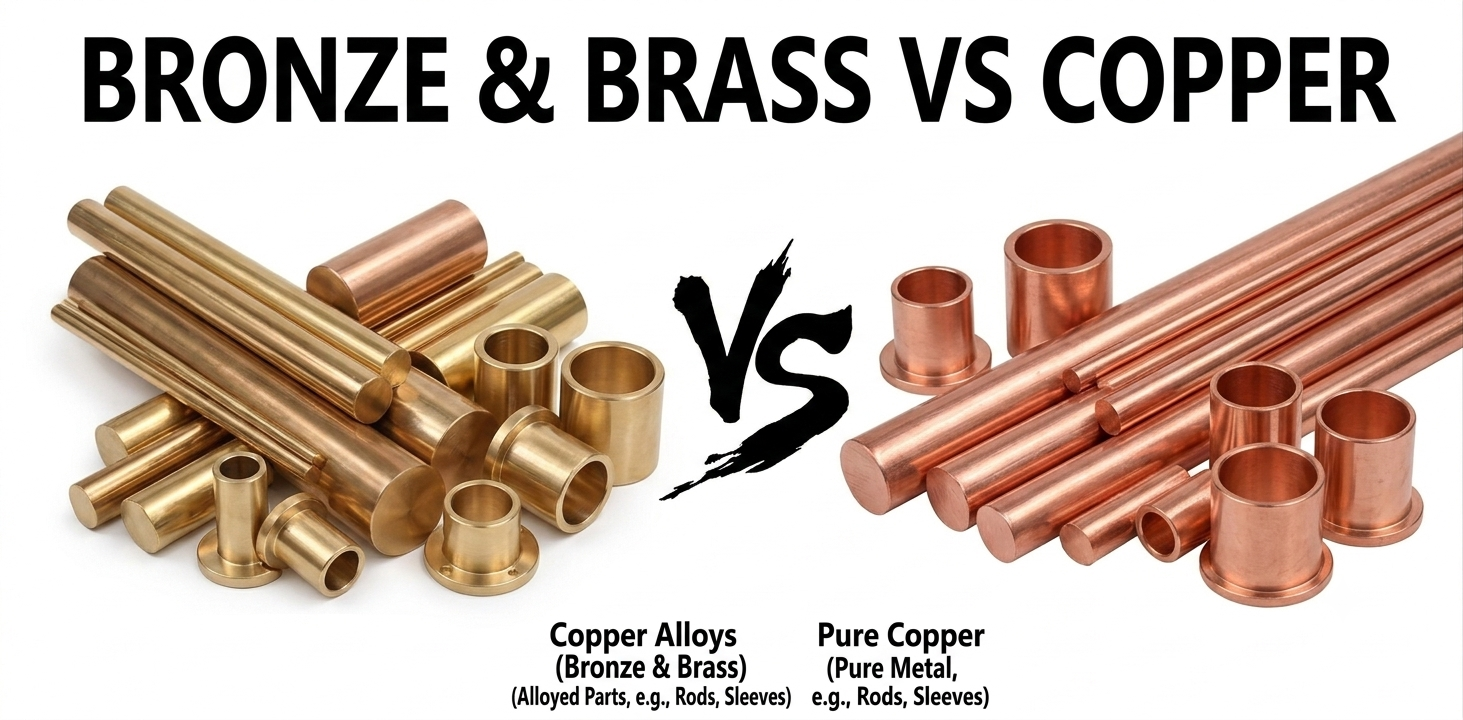
Quick answer: Copper is a pure metal. Brass and bronze are both copper alloys: brass is copper plus zinc, and bronze is copper plus tin, with other elements added for specific grades. That difference in recipe drives everything else. Copper conducts best, brass machines easily and looks yellow-gold, and bronze is harder, more corrosion-resistant, and the usual choice for bearings and marine parts.
Table of Contents
- The short version
- What each metal is made of
- How they compare: properties
- How to tell them apart by color
- Which one costs more?
- What each metal is used for
- How to choose between copper, brass, and bronze
- Where bronze fits: bearings, bushings, and wear parts
- FAQ
- Key takeaways
The Short Version
People mix these three up constantly, and you can see why. They’re all reddish-gold metals, they get used in overlapping places, and two of the three are alloys of the third. Here’s the line that sorts it out:
- Copper is a pure element. Nothing is alloyed into it.
- Brass is copper with zinc added.
- Bronze is copper with tin added (plus small amounts of other elements in most modern grades).
Everything that follows, the color, the strength, the price, the right job for each, comes back to those recipes. Add zinc and you get a softer, cheaper, easy-to-machine metal. Add tin and you get a harder, pricier metal that wears and corrodes far better. Leave copper alone and you get the best conductor of the three.
What Each Metal Is Made Of
Copper is the base for the other two. As a pure metal it runs about 99.9% copper, and grades like C11000 ETP copper are specified mainly by purity and temper rather than by alloying elements.
Brass is a copper-zinc alloy. Zinc content swings widely, anywhere from roughly 5% up to 45%, which is why there are so many brass grades and why their color and strength vary so much. More zinc generally means a stronger, more ductile, paler metal; more copper means a softer, redder one. Free-cutting brass (C36000) adds a little lead for machinability, while naval brass (C46400) adds tin to fight seawater corrosion.
Bronze is a copper-tin alloy, classically around 88% copper and 12% tin, though that ratio shifts with the grade. Tin is what makes bronze hard and corrosion-resistant, but most working bronzes add other elements to tune the properties: phosphorus for wear resistance, aluminum for strength, manganese for very high strength, lead for machinability and bearing performance. That’s how you get phosphor bronze (C51000), aluminum bronze (C95400), manganese bronze (C86300), and the leaded tin bearing bronze C93200 (SAE 660) that most bushings are made from.
One thing worth clearing up: copper does not “turn into” bronze or brass over time. They’re separate materials made by deliberately melting in zinc or tin. Patina on old copper or bronze is surface chemistry, not a change in the alloy underneath.
How They Compare: Properties
| Property | Copper | Brass | Bronze |
|---|---|---|---|
| Makeup | Pure element (Cu) | Copper + zinc | Copper + tin (plus others) |
| Color, freshly cut | Reddish-orange | Yellow-gold | Reddish-brown to dull gold |
| Hardness and strength | Soft | Moderate | Hard, strong |
| Corrosion resistance | Good | Good (zinc can dezincify) | Excellent, especially in seawater |
| Conductivity | Best (the benchmark) | Good | Lower |
| Machinability | Poor, tends to be gummy | Excellent, the free-cutting standard | Good |
| Friction / bearing use | Not used as a bearing | Limited | Excellent, low metal-to-metal friction |
| Relative cost | Tracks the copper price | Lowest of the three | Highest |
| Typical role | Wire, pipe, heat transfer | Fittings, instruments, decorative | Bearings, marine, high-wear parts |
A couple of these deserve a note. Copper sets the bar for electrical and thermal conductivity, which is why it’s the reference everything else gets measured against. Brass is the machinist’s favorite of the three; C36000 is rated at 100% machinability, the benchmark other copper alloys are scored on. And bronze is the one that ended up in load-bearing, sliding, and saltwater duty, because hardness, wear resistance, and corrosion resistance matter more there than conductivity or easy machining.
How to Tell Them Apart by Color
Color is the fastest field check, even if it isn’t foolproof.
- Copper is reddish-orange, almost salmon or pink when freshly polished. It’s the warmest of the three.
- Brass is bright yellow-gold, the closest to the look of gold. The more zinc it has, the paler and more silvery it gets; the more copper, the redder. A high-copper “red brass” can start to look like bronze.
- Bronze is a duller, reddish-brown or muted gold, with brown undertones rather than yellow ones.
Over time they age differently, and that’s another clue. Copper and bronze both build a patina, copper turning brown and eventually green, bronze going dark brown to green. That patina is protective and tends to be left on purpose. Brass doesn’t patina the same way; it simply tarnishes and dulls, which is why brass fixtures get polished to keep their shine.
The honest caveat: color overlaps. A red brass and a tin bronze can look nearly identical, and surface treatment or lighting throws people off. If the part has to meet a spec, color won’t settle it. The only reliable way to know what you have is the alloy designation or a composition test.
Which One Costs More?
Cost follows the recipe, same as everything else.
Brass is usually the cheapest. Zinc is inexpensive, so diluting copper with a lot of it brings the price down.
Copper sits in the middle and moves with the market. As a traded commodity, its price rises and falls daily, and any copper-heavy alloy rides along with it.
Bronze is the most expensive of the three. Tin costs considerably more than zinc, and bronze also tends to carry a high copper content, so both ingredients push the price up. Depending on the grades you compare, bronze can run several times the cost of brass.
For a buyer, the takeaway isn’t to default to the cheapest metal. It’s that bronze earns its premium in the jobs where wear life, load capacity, and corrosion resistance save far more than the material costs up front, and that paying for bronze in a low-stress decorative part, or brass in a heavily loaded bearing, is money spent in the wrong place.
When you compare quotes, compare the cost of the finished part rather than the metal price: material, machining time, scrap risk, inspection, service life, and whether the part can be cut from standard stock or needs a casting. Brass often wins on machining time; bronze often wins on service life in wear and bearing parts.
What Each Metal Is Used For
Copper goes where conductivity rules: electrical wiring and busbars, motor windings, heat exchangers, and water tube. Specialty grades like chromium copper and beryllium copper add strength while keeping much of copper’s conductivity for electrodes, connectors, and springs.
Brass goes where formability, machining, and looks matter more than strength: plumbing fittings and valves, fasteners, locks and door hardware, electrical terminals, musical instruments, and decorative trim. It’s easy to cast, easy to cut, and holds a bright finish.
Bronze goes where parts have to take load, slide, or survive water: bearings and bushings, thrust washers, gears and worm wheels, marine fittings and propellers, valve components, and bells. Its low friction against a steel shaft and its resistance to seawater are the reasons it shows up in heavy machinery and on boats.
How to Choose Between Copper, Brass, and Bronze
Choosing between them is mostly a matter of what the part has to do. Need to carry current or move heat, pick copper. Need an inexpensive, easily machined, good-looking part that isn’t heavily stressed, pick brass. Need strength, wear resistance, low friction, or saltwater service, pick bronze. For an industrial part, start from the main requirement:
| Main requirement | Start with |
|---|---|
| Electrical or thermal conductivity | Copper or a conductive copper alloy, such as C11000 or C10100 OFHC copper |
| Fast machining and low part cost, with no sliding or heavy load | Brass, especially free-cutting C36000, for fittings, hardware, and non-bearing parts |
| The part slides, rotates, carries load, or wears against another surface | Bronze |
| Marine or corrosive service | Aluminum bronze, nickel aluminum bronze, C95800 marine bronze, or naval brass, depending on the drawing |
| The part is a bushing or bearing | Bearing bronze C93200, SAE 841 sintered bronze, aluminum bronze, or manganese bronze, depending on load and lubrication |
Not sure which one your part needs? Send the drawing, the current alloy callout, the application, the mating shaft or component, load, speed, lubrication, quantity, and any corrosion or conductivity requirements. Precision Bronze can review the requirement and suggest a practical material. Request a material quote.
Where Bronze Fits: Bearings, Bushings, and Wear Parts
The reason bronze keeps coming up in machinery is the same reason it keeps coming up here: it slides against a steel shaft with low friction, shrugs off shock and dirt, and resists corrosion, all without the cost and fragility of a rolling bearing. If you’re weighing a plain bronze bearing against a ball or roller bearing, our guide on bearings vs. bushings walks through that choice.
Once bronze is the right material, the part type follows the load:
- Sleeve bushings for radial load, a shaft turning inside a bore.
- Flanged bushings for radial load plus axial location, where the flange gives the housing a positive shoulder.
- Thrust washers for axial load, as a replaceable face between rotating parts.
The grade then follows the duty. C93200 covers most general bearing work; aluminum and manganese bronze step up for higher loads; sintered and graphite-plugged bronze handle poor lubrication; marine bronze handles saltwater. You can compare the chemistry and properties side by side in the bronze alloy material library before sending a drawing.
FAQ
Is bronze the same as brass? No. Both are copper alloys, but brass is copper and zinc while bronze is copper and tin. The different alloying element gives them different strength, color, corrosion resistance, and cost.
Is brass a mix of copper and bronze? No. Brass is copper alloyed with zinc, not with bronze. Bronze is a separate copper-tin alloy. All three are distinct materials.
What is the difference between bronze, brass, and copper in simple terms? Copper is the pure metal. Add zinc and you get brass. Add tin and you get bronze. Copper conducts best, brass machines easily, and bronze is the hardest and most corrosion-resistant.
How can I tell bronze and brass apart? By color and context. Brass is brighter and more yellow; bronze is duller with a reddish-brown tone, and it builds a patina rather than just tarnishing. For certainty, you need the alloy designation or a composition test, because some red brasses look like bronze.
Which is more expensive, brass or bronze? Bronze. Tin costs more than zinc, and bronze carries more copper, so it’s typically several times the price of brass. Copper’s own price floats with the commodity market.
Which is the strongest? Bronze, in general. It’s harder and stronger than both pure copper and most brasses, especially in aluminum and manganese bronze grades. Copper is the softest of the three.
Why is bronze used for bearings instead of brass or copper? Bronze has low metal-to-metal friction, good wear resistance, and high corrosion resistance, and it can be loaded heavily. Copper is too soft, and most cast brass lacks the strength-to-wear balance for high-load sliding service.
Key Takeaways
- Copper is a pure metal; brass is copper plus zinc; bronze is copper plus tin. The alloying element explains every other difference.
- Brass is the easiest to machine and the cheapest; copper is the best conductor; bronze is the hardest and most corrosion-resistant, and the priciest.
- Tell them apart by color (brass is yellow-gold, bronze is reddish-brown) but confirm by alloy spec when it matters.
- Use copper for conductivity, brass for low-stress machined and decorative parts, and bronze for bearings, wear parts, and marine service.
- For bearing duty, match the bronze part to the load (sleeve, flanged, or thrust) and the grade to the operating conditions.