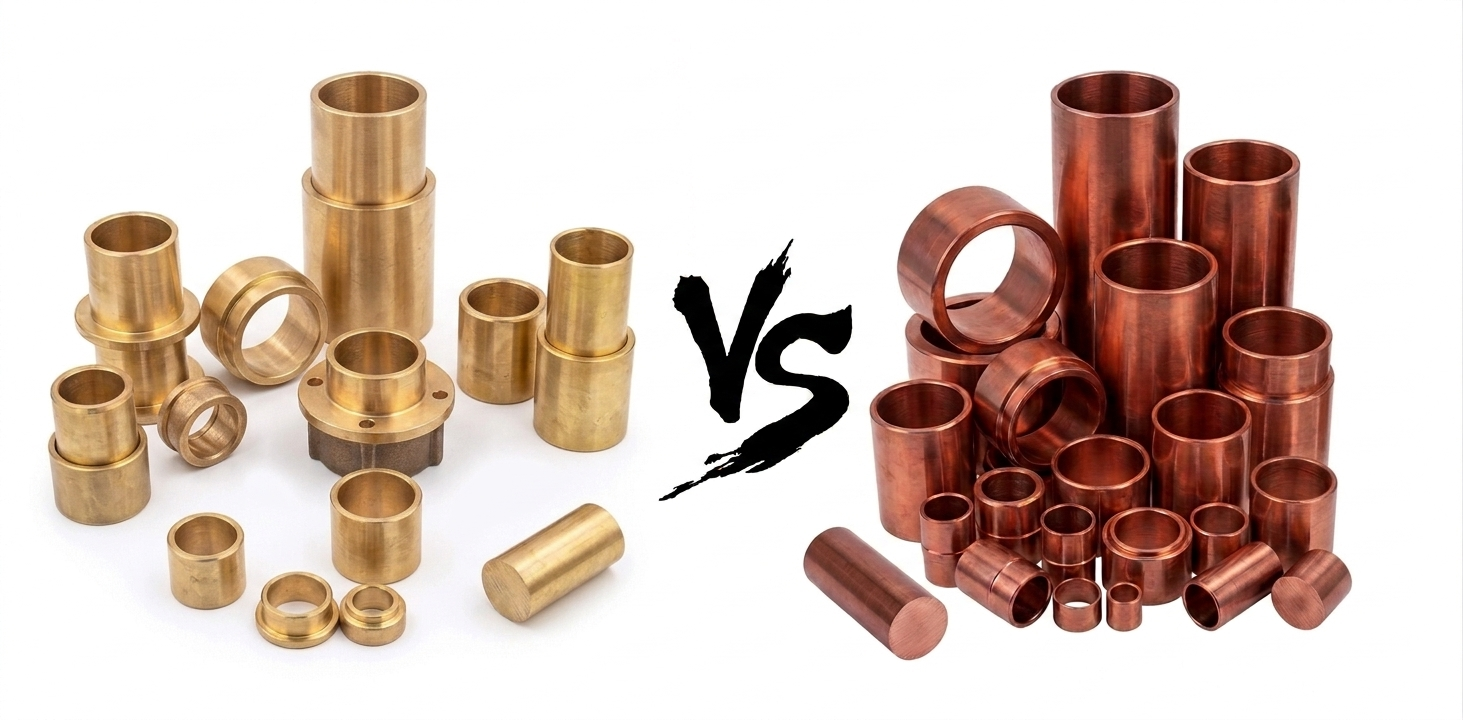
Quick answer: Phosphor bronze is a type of bronze, a copper-tin alloy with a small amount of phosphorus added. The phosphorus deoxidizes the melt and raises the alloy’s hardness, stiffness, wear resistance, and fatigue strength. Compared with standard bearing bronze, phosphor bronze such as C51000 is stronger and springier, which is why it’s used for springs, contacts, and high-fatigue parts, though it’s harder to machine.
Table of Contents
- The short version
- What is phosphor bronze? (C51000)
- How it differs from standard bronze
- When to use each
- Getting the right part
- FAQ
- Key takeaways
The Short Version
Phosphor bronze isn’t an alternative to bronze. It is bronze. The confusion comes from the fact that “bronze” is an umbrella term for a whole family of copper-tin alloys, and phosphor bronze is one branch of that family. What sets it apart is right there in the name: a deliberate touch of phosphorus.
Two things matter when you stand it next to “regular” bronze.
The first is the phosphorus itself. It goes in mainly as a deoxidizer, scrubbing oxygen and tin oxides out of the melt so the metal comes out sound and dense. The phosphorus that stays behind then raises the alloy’s hardness, stiffness, and wear resistance.
The second is the form. Most phosphor bronze is wrought: rolled and drawn into strip, sheet, wire, and bar, then work-hardened to a temper. Many of the bronzes people reach for in bushings, like C93200, are cast. That difference in how the metal is made accounts for a good share of why the two behave so differently.
So when someone asks about “bronze vs. phosphor bronze,” they’re usually comparing a common cast bearing bronze against this harder, springier wrought alloy.
What Is Phosphor Bronze? (C51000)
C51000 is the most common phosphor bronze, also sold as 510 bronze, phosphor bronze 5% A, or just “phos bronze.” It’s a wrought copper-tin-phosphorus alloy.
Composition: copper as the balance, about 5% tin (4.2 to 5.8%), and a small, controlled amount of phosphorus (0.03 to 0.35%), with almost no lead. The tin carries most of the strength and corrosion resistance; the phosphorus adds wear resistance and stiffness on top.
Common names and equivalents: C51000, 510 bronze, phosphor bronze 5% A, phos bronze. These all point to the same alloy.
Phosphor bronze properties
What makes C51000 distinctive is how it responds to cold work. It’s supplied in tempers, and its strength climbs steeply as it’s worked:
- Annealed (soft): tensile around 46,000 to 50,000 psi
- Half hard: about 70,000 psi
- Hard: about 84,000 psi
- Extra hard: about 96,000 psi
That range, paired with a high elastic modulus near 16,000 ksi and good fatigue resistance, is exactly what a spring needs. The metal stores and returns energy through millions of cycles without taking a permanent set. It also holds moderate electrical conductivity, around 15% IACS, which is enough to make it a standard for connectors and contacts that have to flex and still carry current.
The trade-off is machining. C51000’s machinability rating is about 20 against free-cutting brass at 100, which puts it firmly in the “hard to machine” column. It’s a forming and stamping alloy at heart, happiest being drawn, bent, and punched rather than turned on a lathe. If you want phosphor bronze properties in a part you’re going to machine, the leaded free-machining grades such as C54400 exist for exactly that.
How It Differs from Standard Bronze
Put C51000 next to a common cast bearing bronze like C93200 (SAE 660) and the contrast is clear.
| Standard bronze (e.g. C93200) | Phosphor bronze (C51000) | |
|---|---|---|
| Family | Leaded tin bronze | Tin-phosphor bronze |
| Typical form | Cast | Wrought (strip, sheet, bar, wire) |
| Composition | ~83 Cu / 7 Sn / 7 Pb / 2.5 Zn | Cu balance / ~5 Sn / ~0.2 P, little to no lead |
| Tensile strength | ~35,000 psi | 46,000 (annealed) to ~96,000 (extra hard) |
| Hardness | Set by the casting | Tunable by temper |
| Stiffness and springiness | Low | High, the classic spring alloy |
| Fatigue resistance | Moderate | High |
| Machinability | Excellent (rated 70) | Poor (rated 20) |
| Lead content | Yes, aids machining and embeddability | Essentially none |
| Best at | General bushings and bearings | Springs, contacts, fasteners, high-fatigue wear |
A couple of these flip the usual assumption. Phosphor bronze is the stronger, harder, more fatigue-resistant alloy, but the leaded cast bronze is far easier to machine and is the better general bearing material, because the lead helps it embed grit and conform to a shaft that isn’t perfectly true. Stronger does not automatically mean “better bushing.”
There’s also a practical point worth knowing if you’ve inherited a pile of unlabeled stock: you can’t tell these apart by eye. Both are reddish-brown (so are cast phosphor bronzes such as CuSn10P), and the phosphorus content is far too small to change the color. Short of an alloy stamp or a chemistry test such as XRF, there’s no reliable shop-floor trick that separates a phosphor bronze bar from a plain tin bronze one.
When to Use Each
Choose phosphor bronze (C51000) when:
- The part has to flex and spring back: phosphor bronze springs, clips, contacts, diaphragms, bellows.
- It sees repeated load cycles, where fatigue would finish off a softer alloy.
- It’s formed or stamped from strip or sheet rather than machined.
- You need an electrical contact that’s both conductive and resilient.
- Lead has to be kept out of the material.
Choose a standard cast bronze (like C93200) when:
- It’s a plain bearing or bushing carrying load on a rotating or sliding shaft.
- You’re machining the part to size from bar and machinability matters.
- You want the embeddability and conformability that leaded bearing bronze brings.
The two overlap on high-load wear parts and heavy-duty bushings, where phosphor bronze’s hardness and fatigue strength can earn their keep, usually in a wrought or free-machining grade. For ordinary rotating bushings, though, leaded tin bronze is the simpler, cheaper, easier-to-machine answer.
Getting the Right Part
If C51000 phosphor bronze is the material you need, we stock it as bronze flat plate and solid bar for wear strips, guide plates, gears, and high-load bushings, and we machine custom parts to print.
If the job is really a plain bearing, where machinability and easy lubrication matter more than spring properties, C93200 / SAE 660 is usually the better and cheaper pick, available as sleeve, flanged, or thrust bronze parts.
Not sure which way to go? Send the part drawing, the load and motion it sees, and whether it flexes or rotates, and the alloy call is usually clear from there. For the wider copper-alloy picture, our bronze vs. brass vs. copper guide covers how all of these relate.
FAQ
Is phosphor bronze a type of bronze? Yes. Phosphor bronze is a tin bronze with a small amount of phosphorus added. It belongs to the broader bronze family rather than being a separate material.
What is C51000 bronze? C51000 is the most common wrought phosphor bronze, about 5% tin with a trace of phosphorus. It’s also called 510 bronze or phosphor bronze 5% A, and it’s used for springs, electrical contacts, fasteners, and wear components.
Why is phosphorus added to bronze? Mainly to deoxidize the melt, which removes oxygen and tin oxides and gives sound, dense metal. The phosphorus left in the alloy also increases hardness, stiffness, and wear resistance.
Is phosphor bronze stronger than regular bronze? Generally yes, especially in work-hardened tempers. It’s also stiffer and far more fatigue-resistant, which is why it’s used for springs and flexing parts.
Can you tell phosphor bronze and bronze apart by looking? No. They share the same reddish-brown color, and the phosphorus content is too low to change it. You need the alloy designation or a chemistry test to be sure.
Phosphor bronze vs. brass: what’s the difference? Brass is copper with zinc; phosphor bronze is copper with tin and a trace of phosphorus. Phosphor bronze is stronger, springier, more fatigue-resistant, and better in seawater, which is why it’s used for springs and contacts. Brass is cheaper and machines far more easily (free-cutting brass is the 100 on the machinability scale where C51000 rates about 20), so it’s the usual choice for fittings, valves, and decorative parts.
Is phosphor bronze good for bearings and bushings? For high-load or high-fatigue wear, yes, and phosphor bronze bushings are usually made from a free-machining grade. For an ordinary rotating bushing, a leaded tin bronze like C93200 machines more easily and is usually the preferred bearing material.
What’s the difference between C51000 and C54400? Both are phosphor bronze. C54400 adds lead to make it free-machining, so it’s used for machined bearing and bushing parts, while C51000 is the wrought forming and spring alloy with low machinability.
Key Takeaways
- Phosphor bronze is a type of bronze: a copper-tin alloy with a small amount of phosphorus.
- The phosphorus is mainly a deoxidizer, and it also raises hardness, stiffness, wear resistance, and fatigue strength.
- C51000 is the common wrought phosphor bronze (about 5% tin), supplied by temper, and the go-to for springs, contacts, and fatigue-loaded parts.
- It’s stronger and springier than standard cast bronze but much harder to machine (rated 20 vs. 70), so for ordinary bushings a leaded tin bronze like C93200 is usually the better choice.
- You can’t tell the two apart by color, so confirm by alloy designation or chemistry.